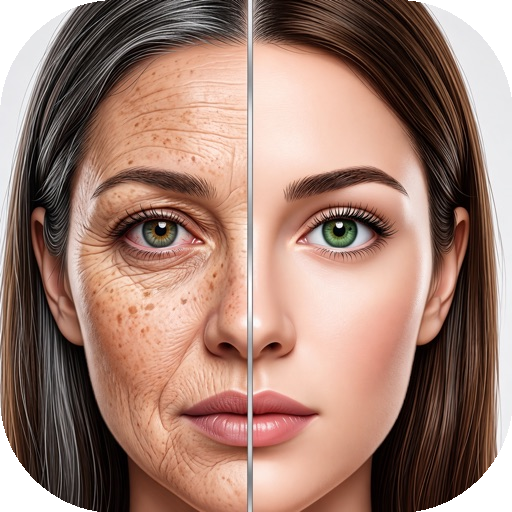
Glow Up Girl.
AI beauty & self-care app · iOS · Solo founder, PM, and builder · Live on the App Store
Self-improvement sticks when you can see yourself clearly. Glow Up Girl is an AI-powered lifestyle app for women that turns a vague ambition (“I want to glow up”) into something concrete: an understanding of your own features, and a routine matched to them.
I built it end to end - product strategy, AI prompt architecture, compliance, design direction, and go-to-market as a solo side project.
Role: Product Manager / Founder · Stack: React Native, Convex, Gemini API · Status: Live
The problem
Beauty and self-care advice online is generic. A 20-year-old with a heart-shaped face, cool undertone and fine hair gets the same “top 10 tips” as everyone else.
The opportunity: use AI photo analysis to give each user a personalized starting point, then convert it into small daily actions.
Version one — and why Apple rejected it
The first build did what the market seemed to reward: a photo scan produced an Overall Score built from 18 graded facial criteria, with a plan to raise it.
Apple rejected it under Guideline 1.1.6 (content that rates or objectifies people). My first reaction was to look at competitors doing the same thing and still live in the store. That was the wrong lesson — live competitors in a high-risk category aren't proof of safe framing; Apple enforces this retroactively. Survivorship bias, not a loophole.
The real problem was deeper than a policy hit: a scoring model tells a user how far she is from an ideal. That's a product built on negative self-perception.
The pivot: describe, don't grade
I rebuilt the product around one governing rule I call the stylist test: a good stylist tells you what you have and what suits it — she never scores your beauty.
That rule became the spec for everything:
Feature taxonomy. Every feature the AI identifies must be a taxonomy of equal kinds — face shape (oval, round, heart…), eye shape, brow shape, skin type, undertone, colour season… never a degree on a scale. Jawline, nose shape, lip fullness and proportion ratios were deliberately excluded and the rationale documented, so the decision never gets relitigated.
The pivot cost a redesign of the core loop. It also produced a differentiated position in a category full of looksmaxxing clones.
How it works today
1. Scan. A selfie or a photo of your hair or outfit.
2. Understand. The AI identifies your features descriptively.
3. Plan. Every feature maps to matched styling, skincare and care recommendations.
4. Track. Track your progress.
Glow Up Girl is free with in-app purchases, on the App Store.
Glow Up Girl, the short version.
- What — an AI beauty & self-care app for iOS that turns “I want to glow up” into an understanding of your own features and a routine matched to them.
- Role — solo founder, PM and builder: product strategy, AI prompt architecture, compliance, design direction, go-to-market. Stack: React Native, Convex, Gemini API.
- The turn — v1 scored faces on 18 criteria and Apple rejected it (Guideline 1.1.6); competitors still live in the store were survivorship bias, not a loophole — and a scoring model builds on negative self-perception.
- The pivot — the “stylist test”: describe, don't grade. Features are a taxonomy of equal kinds (face shape, undertone, colour season…), never a degree on a scale — with the exclusions documented.
- Today — scan → understand → plan → track; free with in-app purchases, live on the App Store.
Describe, don't grade.